Each of us, as we live in this world, often hears inspiring phrases like “dare to dream” or “set big goals.” But have you ever wondered—does dreaming alone really make things happen? Antoine de Saint-Exupéry, the author of the timeless classic The Little Prince, once said something powerful: “A goal without a plan is just a wish.”
Antoine de Saint-Exupéry – Author of Timeless Wisdom
Born in 1900, Antoine de Saint-Exupéry was a French writer, poet, and aviator. He's not only famous for The Little Prince – one of the best-selling books of all time – but also for his deeply humanistic, philosophical, and thought-provoking writings.
Saint-Exupéry began his flying career at a young age, and his experiences soaring through the vast skies provided the inspiration for his poetic and philosophical works. Some of his most renowned books include:
- Night Flight (1931)
- Wind, Sand and Stars (1939) – Winner of the U.S. National Book Award
- Flight to Arras (1942)
- The Little Prince (1943)
The Meaning Behind "A Goal Without a Plan Is Just a Wish"
This seemingly simple statement carries a profound message: if you have a dream, you need to create a plan to make it happen. Don't just keep wishing without taking any action. Equally important is that if you set many different plans without actually strategizing or figuring out where to start, all your goals and aspirations might just vanish into thin air. You'll be left endlessly dreaming about an unattainable ideal.
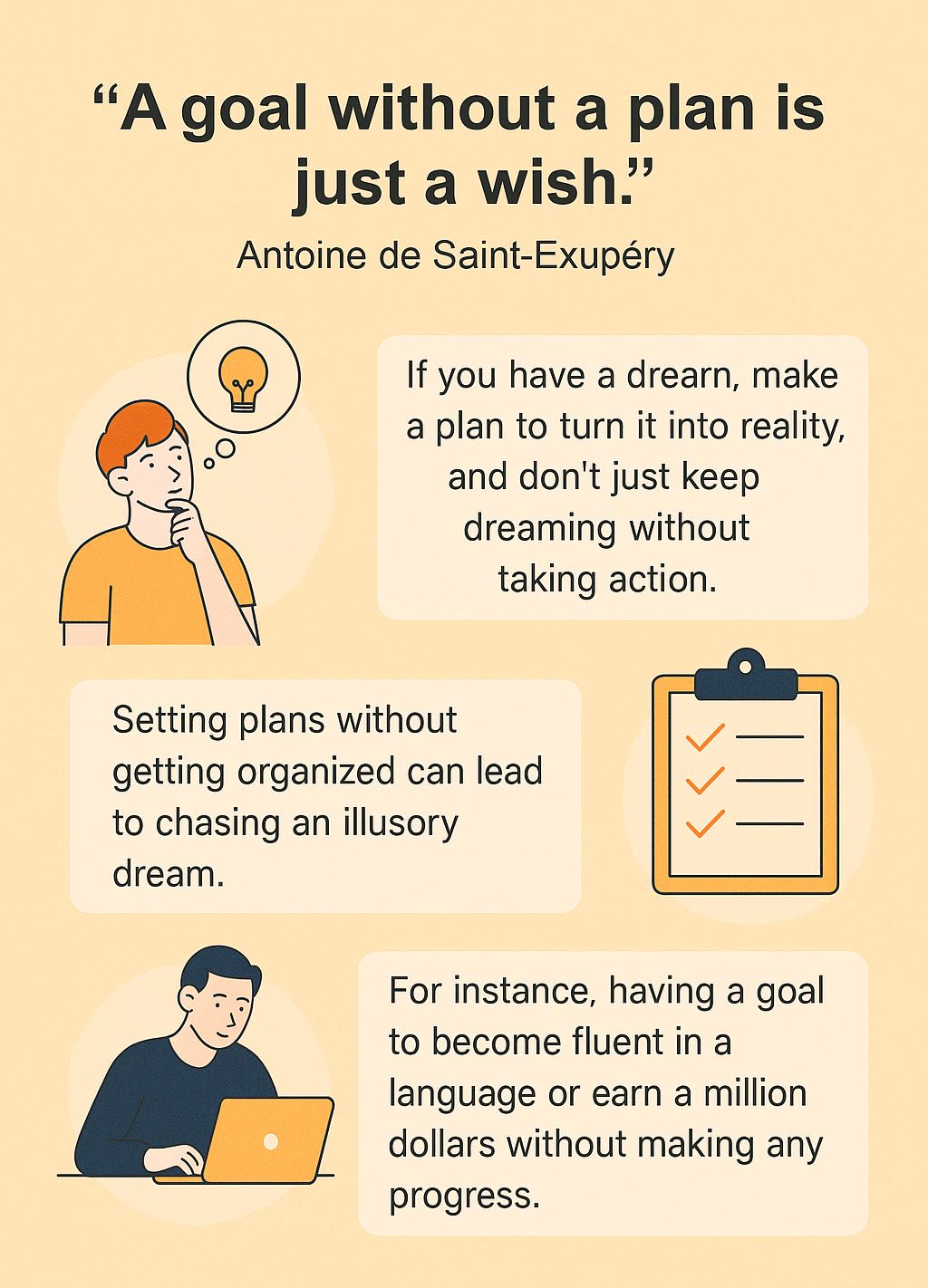
Meaning quote "A goal without a plan is just a wish
For instance, if you aim to become fluent in a foreign language within three months or want to earn a million dollars, but you let those goals sit there without any progress, that perfectly illustrates how having a goal without a plan renders it meaningless.
Other Famous Quotes by Antoine de Saint-Exupéry
Here are some other inspiring and insightful quotes from Antoine de Saint-Exupéry to motivate you in life and help you become stronger every day:
1- What is essential is invisible to the eye.
2- Perfection is achieved, not when there is nothing more to add, but when there is nothing left to take away.
3- You become responsible, forever, for what you have tamed.
4- Love does not consist in gazing at each other, but in looking outward together in the same direction.
5- He who would travel happily must travel light.
6- It is only with the heart that one can see rightly.
7- A rock pile ceases to be a rock pile the moment a single man contemplates it, bearing within him the image of a cathedral.
8- True love begins when nothing is looked for in return.
9- As for the future, your task is not to foresee it, but to enable it.
10- Tell me who admires and loves you, and I will tell you who you are.
In conclusion
The quote “A goal without a plan is just a wish” isn’t just advice—it’s a wake-up call. It reminds us that if we want to achieve our dreams, we have to put in the effort to plan and take action. Only then can we turn our wishes into something real. So if you have a dream or a goal, don’t let it fade into the background. Map it out, take the first step, and keep going. Because a dream backed by action is no longer just a wish—it’s your future in the making.